
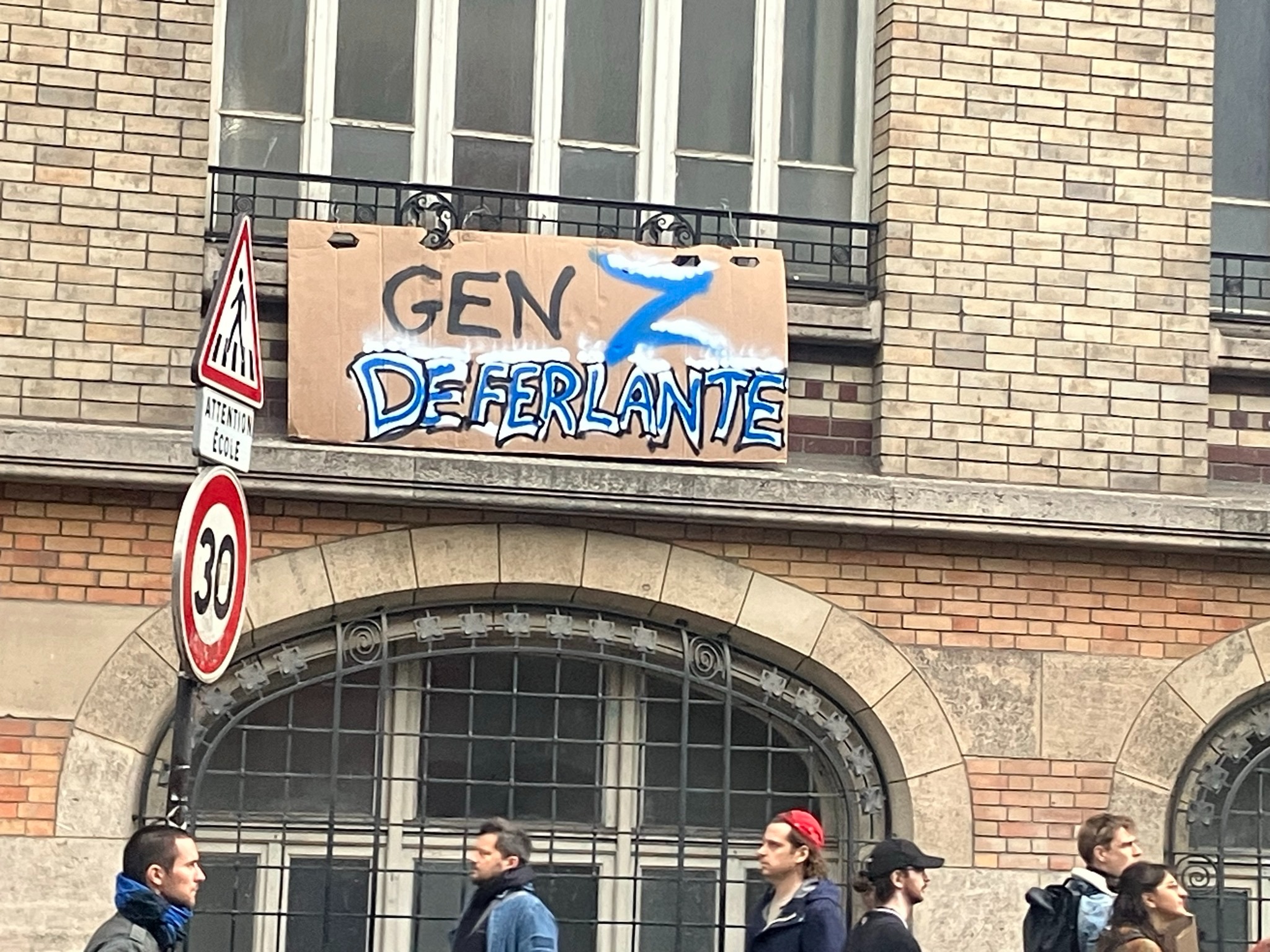
Written by Janette Zahia Corcelius & Jane Léonie-Bellay who interviewed students Smeal, Léon, Hamet, & Julia
Introduction
By Janette Corcelius
Janette Zahia Corcelius is a member of the Twin Cities Democratic Socialists of America. Her background includes being a public school music educator and a union organizer.
What started as students striking for better learning conditions, has now become a widespread revolt against austerity, racism, & neocolonialism. There is a looming threat of a potential fascist takeover with the upcoming 2027 presidential elections in France. Since the interviews were conducted and concluded on October 16th, French trade unions such as the CGT, CNT, CFDT, UNSA, Solidaires, & FSU, FO & Solidaires have announced that they will be going on a nationwide general strike on Thursday, November 5th.
President Macron’s neoliberal policies have squeezed the French working class beyond the brink. Like the United States, the extreme right in France attacks immigrants, migrants, and formerly colonized peoples, using them as political punching bags and scapegoats. The toxic mixture of xenophobia and Islamophobia in the western world serves as a distraction to the working class when they should draw their ire to the trillionaires and billionaires hoarding wealth, the zionist genocidal project against Palestinian peoples, the illegal and unpopular war in Iran, and the existential threat of climate catastrophe.
In the last four years, seven former French African colonies such as the Central African Republic, Senegal, Mali, Burkina Faso, Benin, Guinea, Ivory Coast, and Niger have finally pushed out the French government and their troops, leaving France in an economic crisis as they can no longer exploit the wealth and the richness of these African countries.
France, like many countries in the western world, has spent billions of dollars supporting Israel’s genocidal project. Macron allowed 525 shipments of military components destined for Israeli factories to arrive over the course of two years and in 2024 French arms sales to Israel hit a record high. Students in the western world are well aware that the highest number of amputated children in modern history are in Palestine. Palestinian children have been left orphaned while their education has been disrupted while experiencing scholasticide alongside the genocide. The student protesters don keffiyehs and wave Palestinian flags, showing their solidarity.
Prioritizing the military industrial complex over public education has left schools dilapidated and overcrowded in both France and the United States. The students who learn in these neglected buildings with overworked, underpaid, and under-resourced educators despair about their education and their future. In the United States, decades of underfunding and privatization through charter schools and voucher schemes has led to school enrollment drops, school closures, educator shortages, and worsening educational outcomes. Lasting impacts of redlining, alongside the privatization push have created a new form of segregation. In France, students in the outer ring suburbs of Paris come from lower socio-economic backgrounds. Testing at 15-years-of-age determines your path in life: general schooling, vocational school, or technological school. These students are revolting against an inequitable system designed to lock them in for the rest of their lives. They are continuing a long legacy of French revolutions: 1789, 1830, 1848, Paris Commune in 1871, & May 1968.
The demonstrations on October 17th harken back to 65 years ago, on October 17th, 1961, Algerians in Paris marched peacefully for their independence while the decolonial struggle was being fought on their ancestral lands since 1954. French police arrested 10,000 protesting Algerians, killing at least 100 of them by throwing them in the River Seine to drown. The French government still has yet to fully acknowledge, recognize, and apologize for committing state-sanctioned murder. A year later, in 1962, the Algerians would finally win their independence against the French, but 1,500,000 million Algerians were killed in the war. Much like in the United States, Black, Arab, and North African peoples in France are more likely to be stopped, frisked, and killed by the police. The history of police brutality in the United States against Black and First Nations peoples is inextricably linked to the history of chattel-slavery, settler-colonialism and genocide. From the founding of the American Indian Movement in South Minneapolis with the AIM patrols keeping an eye on the police to protect their community in 1968, to the Black Panther Party celebrating its founding and formation 60 years ago this month, to the Black Lives Matter uprisings in 2014 in Ferguson for Mike Brown, 2015 in Baltimore for Freddie Gray, and the George Floyd Uprising in Minneapolis in 2020, to the resistance against ICE across the nation from 2025 to this current moment. Police protect and serve the bourgeoisie, white supremacy, and interests of capital.
An infant like Kohen Wiley in Mississippi murdered by the police and his murderer defended by a so-called “pro-life” attorney general to 6-year-old Hind Rajab murdered in Gaza with the IDF killer roaming free in the United States, and Eden the 14-year old in Saint-Ouen-l’Aumône from the north-west of Paris who suffered facial injuries (two fractures to his jaw, the loss of his bottom teeth and all his top teeth broken) are examples of a violent, globalized attack on our youth. Our children are innocent and precious– yet they suffer so much through violence, neglect, and indifference. In light of the Epstein files being made available to the public, no justice has been served for the children who are victims and survivors of human trafficking.
Capitalism is a death cult where children will continue to be murdered, maimed, and abused. Standing in solidarity with children looks like adults stand up for their right to safety, dignity, and autonomy. It looks like Saint-Denis Mayor Bally Bagayoko who is a member of La France Insoumise putting his body on the line to stop the police from brutalizing students. It looks like educators going on strike because teachers’ working conditions are students’ learning conditions. It looks like resisting the rollback of child labor laws. There is hope on the left that this student movement sparks a socialist revolution in Europe. “Bismillah, c’est les ténèbres” (In the name of God, it’s the darkness) as a specter is haunting Europe…
The Interview
Jane-Léonie Bellay is living in Paris and a mother of an 8-year-old child. She is a civil servant at the Ministry of Justice, union activist with the FSU (Fédération Syndicale Unitaire), and an anti-globalization & decolonial activist. She has relationships with all the French students in this interview through her various political activities and helped Janette gather diverse student voices for this interview. The students interviewed were:
- Smael Afnaï, a 16-year-old high school student activist in Montreuil (a Paris suburb).
- Léon is a senior at the Louise Michel vocational high school in Grenoble (France), specializing in health and social technology. At his school, there is no student union; the students have organized themselves. This is generally the case in France.
- Hamet Nimaga, a high school student and representative of the Lycée Jean Macé in Vitry-sur-Seine in the 94th Department, just southeast of Paris.
- Julia is a 23-year-old woman living in Lyon who is preparing for the entrance exam to become a primary school teacher.
Jane-Léonie: To set the stage, it is important to note that the high school student movement began in Mayotte, an island in the Indian Ocean near Réunion, which became a French department in 2011. [The protests] then spread to French Guiana, a former French colony that became a French department in 1946. In fact, the high school student movement began on August 31st at the Lycée de la Cité du Nord in Mayotte and then spread across the entire island— with students and teachers acting together in most cases until the school break on October 10th. The movement then spread to the Félix Eboué High School in French Guiana on September 7th, followed by the Melkior-Garré Comprehensive High School and the Bertène-Jumine High School in French Guiana, and then— as in mainland France— to Martinique, Guadeloupe, Réunion, and Tahiti. Police violence was just as widespread overseas, but as with the high school strikes– and as is customary– not a single word was mentioned in the mainland French press, which remains deeply colonial in its outlook, regarding these events for several weeks. Subsequently, the movement in mainland France took root at the Saint-Exupéry High School in Créteil on September 21st, which was the first to be blockaded.
How did the student movement begin, and what are its main demands?
Smael: The student movement began with the blockade of Saint-Exupéry High School in Créteil (a Paris suburb). The demands centered on a lack of resources at the school and a resulting shortage of staff (teachers, nurses, etc.). This was followed by videos on social media and a wave of blockades at other high schools, as students observed the same lack of resources within the national education system.
Léon: The student movement began at a disadvantaged high school in Créteil, then spread to other disadvantaged high schools, and now all high schools are mobilizing around demands that include more resources for suburban high schools neglected by the government, the end of Parcoursup [a web portal that manages admission to higher education nationwide], the hiring of new teachers, etc.
Hamet: The movement first began at Saint-Exupéry High School in Créteil, then spread to other schools in Val-de-Marne (94th Department), the Île-de-France region, throughout France, and finally to several European countries.
Julia: The movement began at a high school in Val-de-Marne, in the Paris region, at a school where learning conditions are very difficult. The students are calling for more resources for education, more teachers, school psychologists employed by the Ministry of Education, nurses… Very quickly, a large number of high schools across France joined the movement, demanding not only additional staff but also financial resources to bring a number of schools up to standard and renovate them. Finally, some demands challenge the current learning conditions by criticizing overly packed schedules and selection systems like Parcoursup, which cause anxiety for high school students throughout their high school years.
Pretty quickly, college students joined the movement by organizing through general assemblies and staging their own blockades of their campuses. In Lyon, various campuses were blockaded, including buildings where blockades are very rare. The same was true in Nice, where the College of Arts is in a state of serious disrepair… And surely the same is true in many other cities.
How did the French government react?
Smael: The French government responded with heavy-handed police repression (more than 7,000 people taken into police custody to date, 96% of whom are minors). Several students were notably injured.
Léon: The government initially resorted to police repression and continues to do so. The only real, concrete measures announced since the movement began have been the allocation of 3,000 substitute teachers.
Hamet: The French government responded with severe repression, deploying law enforcement officers who engaged in acts of violence (beatings, people having their eyes gouged out, broken teeth) and physical assaults against French youth.
Why are unions and social movements getting involved, and how? What is the relationship between the student movement, the unions, and the left?
Smael: Relations between the student movement, the unions, and the left are generally good. The student movement sets the dates for mobilizations following their General Assemblies (it sets the pace). The unions join in on those dates, and the left comes out to support the blockades and participates in the demonstrations.
They are getting involved because, for the vast majority, these are the demands they have long championed— it is their cause. And they are getting involved by participating in the scheduled protests and sharing information about the demonstrations on social media.
Léon: I think the other unions are also mobilizing, because this is not a new problem because the French people are fed up with our government, which doesn’t listen to us, and does nothing but erode the purchasing power of the French by making the rich even richer at the expense of the people.
Hamet: Unions and social movements are getting involved to align the high school students’ cause with that of workers. They are taking concrete action by informing students of their rights in the event of police custody, providing free legal representation, and offering logistical support during protests. All of this is of great help to young people.
As for the left, it provides us with political and organizational support, but it does not interfere with the high school general assemblies. This preserves our genuine independence and prevents us from feeling patronized.
Julia: The social movement is involved in this mobilization in various ways. First, they are filing strike notices and calling for demonstrations based on the high school students’ demands and by expanding upon them. For example, education unions have championed the high school students’ demands by expanding them to include the working conditions of educational staff. Other unions have also come out in support of the high school students’ struggles, both in terms of their demands and in the face of the repression they have endured.
I believe one of the key challenges for the unions was to protect the high school students from police violence by standing by their side and providing them with material support (megaphones, sound systems, signs, etc.) and legal assistance (a help desk for accessing legal rights, referrals to lawyers, etc.).
Unions and left-wing organizations support the high school student movement in various ways and to varying degrees. Sometimes by being on the ground with them and trying to protect them. I’m thinking in particular of certain elected officials—notably members of La France Insoumise—who have tried to dissuade the police from charging or firing on high school students. They also provide material and legal support without interfering with the students’ general assemblies or their decisions.
What is the far right saying, and how might these events influence the 2027 elections?
Smael: The far right obviously supports law enforcement and not the students, arguing that students’ only right is “to go to class, sit down, and keep quiet.” And these events could influence the 2027 elections because they are currently a major focus of public debate.
Léon: The far right is quite pleased with the situation because it’s capitalizing on the anger of high school students, who sometimes vandalize things like trash cans, and it uses this to claim that if it were in power, there wouldn’t be these “problems with delinquency.” It also uses this to attack its opponent, La France Insoumise.
High school students are continuing their struggle despite heavy police repression and the violence used by the police..
Hamet: The far right refuses to listen to young people. It insists that the majority of young people simply want to study and work, adding that at our age, the previous generation faced the same problems. Young people respond that just because past generations endured these injustices without speaking out or rebelling doesn’t mean we have to do the same.
Julia: The far right is taking a nuanced stance. First, some far-right groups, such as Action Française (royalists), are trying to co-opt the movement by arguing that the demands made by high school students are legitimate but that violence is unacceptable. They advocate a return to order and a more peaceful approach to the struggle. Others condemn the movement, claiming it has been co-opted and led by La France Insoumise, and downplay the high school students’ demands. One might hear people say, “We used to have tough times too; young people just don’t want to work anymore”… Finally, some racism is directed toward the mobilized high school students because the movement began in working-class neighborhoods where educational conditions are particularly poor.
What type and scale of organization have the students managed to establish?
Smael: The students organize themselves through General Assemblies. They gather in committees by high school and college and propose and vote on decisions regarding the next steps in the mobilization. Other General Assemblies are sometimes convened, but on a larger scale—by city, for example.
High school students are continuing their struggle despite heavy police repression and the violence used by the police.
Hamet: The students have succeeded in providing unprecedented support to high school students: a convergence of this magnitude between high school and college students had not occurred since May 1968. This has given much greater visibility to all of the demands.
Julia: I would say that this high school student movement is an experience for them in collectively organizing a group, a struggle, a blockade… Decisions are made in general assemblies about what they want to do and how they want to do it. The unions and political youth organizations that have traditionally been at the center of social movements are not behind this mobilization, even though they are present and come to support the high school students… I would say that the way high school students organize can vary: some are driven by political motives, others by union interests, and still others remain within an organization at the level of their high school or local community. But there is a desire among some of them to become more structured. For example, we’re seeing youth action groups form in several cities within La France Insoumise (and this is surely the case in other organizations as well).
Are there clearly defined political factions among the students, and do certain adult organizations play a role in the students’ politics or organization?
Smael: Yes, the left-wing faction is clearly at the heart of the student movement. This is because the movement also champions left-wing demands (more funding for the National Education System) and (public services in general). But the movement has grown so much that even right-wing students are participating, and some of them are shifting to the left as they listen to and come to understand the movement’s demands.
Léon: La France Insoumise (which is a political party in France) has elected officials that have been coming to the demonstrations and blockades to help the high school students and protect them from violent police.
Hamet: Yes, political factions exist within certain high school student organizations. While this may sometimes appear to be political co-optation on their part, it also brings us visibility in return. Their attempts to influence us do not alter our initial demands, and they help us organize.
The high school students involved in the movement are highly politicized. They sometimes hold very materialist views and are acutely aware of inequalities in life, particularly regarding access to education. But they are also aware of discriminatory inequalities based on where they study and their presumed background… There also seems to be an anti-imperialist or decolonial perspective. This is evident in the number of Palestinian flags and demands related to international issues. One notable connection is the belief that all children should have access to school—which is not the case everywhere, particularly in Palestine… However, I think the movement is diverse, with varying levels of politicization and different political stances. And it seems important not to essentialize high school students.
I believe that “adult organizations”—such as associations, political parties, and unions—provide support. Their role is not so much to help high school and college students organize themselves but to provide support and experience… However, there has been a call for a general strike by the CGT on November 5th.
Is it mainly high school students, or has the movement spread to colleges and universities?
Julia: The movement began in high schools but is continuing in institutions of higher education. Numerous general assemblies are taking place on college campuses in an effort to organize the struggle. Many blockades have occurred. Students are mobilizing for more funding for higher education, the renovation of a number of buildings, against the elimination of housing assistance, and against the admissions processes via Parcoursup and “Mon Master” [a web portal for admissions to masters programs nationwide]…
But some are also adopting an anti-imperialist stance. In fact, this morning at INSA [a network of public graduate engineering schools], only the buildings that have partnerships with arms manufacturers were blockaded. A connection is being drawn to the month-long campaign against the arms industry led by a number of organizations, such as the Stop Arming Israel collective.
How many protesters are being held in jail, and for how long?
Smael: 7,000 students have been taken into police custody (held in a cell for 24 or 48 hours and then released). However, students are not imprisoned indefinitely. Still, this is unprecedented and represents an unprecedented level of violence, as never before have minors (under 18) been subjected to such repression and taken into police custody.
What impact will all of this have on the elections?
Smael: All of this has a real impact on the elections because this movement is raising awareness and politicizing a huge portion of the youth, who are now aware of the issues at stake and the importance of voting in 2027. And this increase in youth voter turnout in 2027 will play a major role in the victory of the radical left, led by Jean-Luc Mélenchon’s candidacy.
Léon: The impact this movement will have on the upcoming elections will be a double-edged sword. Because people who have seen the problems will, I think, be more inclined to vote for the left, but there are also many people who will have seen only what the media reports—and since the media shows only the most striking and violent images—they’re afraid and think this high school movement is just a pretext for causing chaos.
Hamet: The images of repression seen by all French people are making people realize that change must happen as soon as possible. The high school student protests are not intended to wait for the election in six months, but to achieve results as soon as possible.
Julia: This movement brings to the forefront the issues of public services, education, discrimination, and equality—all themes championed by the left. Furthermore, the support from La France Insoumise and other left-wing political groups for the high school student protests may lead these young people to vote more toward the left. Moreover, this mobilization is creating a dynamic of engagement and politicization among young people, which is positive for the radical left. And as we’ve seen, this is also reflected in the formation of political organizational branches, such as the “Insoumis” action groups. However, the anger on the streets does not always translate into votes at the polls, so it seems to me that we must undoubtedly remain cautious and continue to mobilize without assuming that victory is already assured. And, in my view, we will need to be vigilant against the far right co-opting the movement and against rhetoric that could exploit the movement for racist electoral purposes.


